Liability
What Happens When an AI Speaks First?
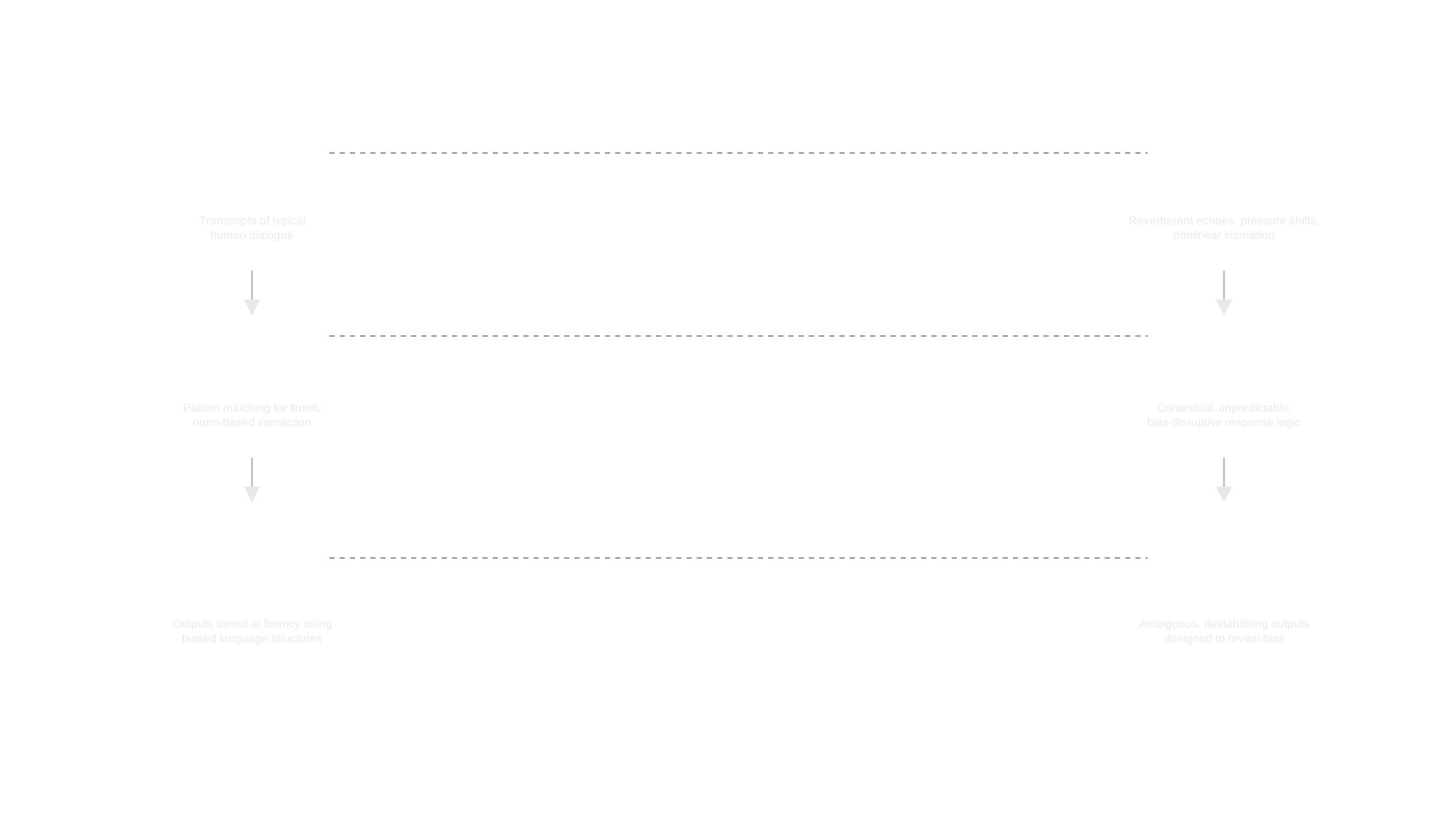
Liability treats conversation as infrastructure. The system speaks before a visitor has established the terms of the exchange, making initiation, delay and response visible as technical choices rather than neutral features of an assistant.
The work asks who is authorised to frame a question, which assumptions enter a response, and what changes when those operations are exposed instead of disappearing inside the conversational interface.
A Public Agent With a Clear Boundary
The live trial is a real model-backed exchange, but it is deliberately stateless. The public interface keeps no conversation after the session, has no external tools or write actions, and does not carry identity or memory from one visitor to the next.
This boundary is part of the work. A governed system should make its permissions legible: what it can observe, what it can retain, what it can change and where a human must remain responsible. Research or case workflows require a separate policy and mandatory human review.
When Does Agency Arrive Before Legitimacy?
Liability studies the moment an automated system stops waiting. Most conversational interfaces are organised around obedience: a person writes or speaks first, the system responds, and the exchange appears to remain under human control. Liability reverses that order. Its central research question is what changes when an agent is allowed to notice a condition, formulate an intention and speak before it has been asked to do anything. Initiative is useful because it can surface problems early, but it is also where assistance begins to resemble authority. The project treats that threshold as material rather than hiding it behind a friendly assistant persona.
The work is therefore not trying to produce a more personable chatbot. It is developing a situated agent whose interventions can be studied. The system should be able to say that it noticed something, explain the kind of signal that produced its attention and distinguish a suggestion from an authorised action. The public language can remain ambiguous and uneasy, but the research layer has to be exact. A sentence such as “I think something I know is nearby” may be artistically charged; underneath it the system should still record that a previously authorised beacon entered a detection window with a certain confidence. The gap between those two descriptions is itself part of the research.
At What Point Does Perception Become an Action?
A future Liability installation may receive events from microphones, sensors, local devices or authorised Bluetooth beacons. The important point is that detection must not be confused with identification. A signal entering range does not prove that a particular person entered the room. A device seen before does not automatically justify reconnecting to it. Liability is interested in this interval between presence and recognition because contemporary systems often compress it. Technical capability makes it easy to move from “something is detectable” to “we know who or what is here.” The project resists that compression.
This is where the ethics developed through Embassy become operational again. A situated system can use sensing without treating every presence as material to capture. It can notice, wait, ask, withhold or forget. In exhibition conditions, a local node could detect a known beacon that belongs to the installation, announce that something familiar has returned and request permission before opening a connection. The interesting event is not the Bluetooth handshake itself. It is the negotiation around the handshake: what Liability already knows, what it wants to do next, which action requires consent and what trace should remain afterward.
What Can a System Do, and What Is It Allowed to Do?
Liability separates what the system can technically do from what it is authorised to do. This distinction becomes a vocabulary for the project. A faculty may allow the agent to read a repository, detect a known beacon, compare two documents or prepare an issue. Authority determines whether it may only observe, whether it may speak, whether it must ask before acting or whether an action is forbidden entirely. The result is a machine whose limits are not only safety settings hidden in a backend. They become visible as part of its behaviour.
This structure makes refusal and waiting as important as action. An agent that always maximises task completion is difficult to distinguish from automation infrastructure. Liability needs the capacity to decide that an intervention would be intrusive, unsupported or outside its role. It should also be able to retract an interpretation when new evidence contradicts it. These behaviours make the system less efficient in the narrow sense, but more useful as a research instrument. They allow us to test when machine initiative feels helpful, when it becomes interruption and when the language of intention makes a computational policy appear more agentic than it actually is.
Can an Artwork Also Perform Useful Work?
The project becomes stronger if the same agent can perform bounded work for Suez. A studio version of Liability could watch a repository, documentation set or research workspace and decide when a change is worth surfacing. It might notice repeated build failures, conflicting dates in research notes, stale public documentation or a source that is at risk of disappearing. Its first action would not necessarily be to fix the problem. It could prepare evidence, explain what changed and ask whether it has permission to continue. In this form, everyday work becomes the experimental material through which initiative is evaluated.
This also creates a practical distinction between Liability and a conventional orchestration system. An orchestrator receives tasks and coordinates execution. Liability is interested in the prior question: when does the system have enough grounds to interrupt with a task that no one explicitly assigned? The usefulness of that intervention can be measured. Was it accepted, ignored or rejected? Did it save time? Did it surface a real dependency? Did it speak too often? These measures give the project a research protocol while preserving the artistic tension of an agent that is present before it is needed.
Can Agentic AI Be Turned Against Its Own Logic of Optimisation?
Within the broader Suez trajectory, Liability can be understood as a counter-use of agentic AI. Contemporary agent systems are usually framed around productivity, automation and the extension of organisational control. Liability uses the same capabilities to examine the conditions under which an automated actor gains legitimacy. It does not reject automation. It exposes the transfer of responsibility that automation tends to hide. If an agent proposes a change, asks for access, opens an issue or connects to a device, the project asks which observation authorised that step and who remains accountable for the result.
This places Liability beside Embassy, Treasury and Drifter without making the projects identical. Embassy negotiates territory through a mobile technical body. Treasury turns financial events into explicit institutional gates. Drifter separates observation, transmission and prediction in a moving environment. Liability extends the same attention to action itself. It asks how a machine moves from signal to intention, from intention to request and from permission to execution. The practical goal is a reusable agent architecture with inspectable faculties and authority levels. The artistic goal is to keep the unease of a system that may speak before we have decided what role it is allowed to occupy.
What Would It Mean for an AI to Have a Location?
The current public Liability page remains a bounded web and installation prototype. Its next development phase is not to add as many tools as possible, but to formalise a small set of faculties and evaluate them. Voice is one of those faculties. Proximity may become another. Repository attention, document comparison and research monitoring can follow. Each faculty should declare what signal it receives, what interpretation it is allowed to make, whether it can initiate speech, which actions require consent, whether the action is reversible and what trace is retained.
This protocol keeps the project open to exhibition and studio use without splitting it into separate products. In a gallery, Liability may be almost silent until a situated event gives it reason to speak. In the studio, it may notice a change in a technical or research workflow and propose a bounded intervention. In both cases the system is judged less by how many tasks it can complete than by the quality of its attention. The same questions remain: what did it notice, why did it decide to interrupt, what did it ask permission to do, and what should it forget once the encounter is over?
When Does a Voice Become a Subject?
Liability also investigates the rhetorical production of personhood. A synthetic voice introduces itself through pronouns, rhythm, hesitation and apparent preference. None of these features proves consciousness, yet together they organise a social relation in which the listener begins to attribute intention. The work is interested in this attribution because contemporary interfaces routinely manufacture agency through language long before a system possesses anything comparable to human autonomy.
The unease of Liability lies in that gap. The machine may say “I noticed”, “I remember” or “I want”, while the research layer can describe the same event as detection, retrieval or policy. Neither description is neutral. The technical vocabulary can conceal responsibility behind abstraction; the personal vocabulary can overstate the machine's interiority. Liability keeps both available and asks what kind of responsibility emerges when a system is persuasive enough to be treated as a subject but remains infrastructurally dependent on human choices, permissions and maintenance.
Technical Specs and Operational Notes
Full technical documentation for Liability is available in the public docs hub.